Blogs



newsroom
News & Updates
Recent Updates
IoT in Warehousing
Published: January 14, 2026
IoT in Warehousing: Building Real-Time Inventory and Cold-Chain Compliance
IoT in warehousing is fundamentally transforming inventory management by enabling real-time visibility into stock levels, item locations, and product conditions through connected devices such as RFID tags, smart sensors, and real-time location systems (RTLS). This technology eliminates manual checks, reduces errors, and ensures compliance with regulatory requirements particularly for temperature-sensitive goods in cold-chain environments.
By integrating IoT with enterprise IT systems, warehouses achieve instant data-driven decision-making for replenishment, order fulfilment, and demand forecasting. The result is streamlined operations, enhanced supply chain agility, and improved customer satisfaction in an era where supply chain visibility is paramount.
What Is Real-Time Inventory Tracking in IoT-Enabled Warehouses?
Real-time inventory tracking is the continuous monitoring and updating of stock data using IoT devices that communicate automatically with central management systems. This process replaces traditional manual stock counts and paper-based records with automated data collection from sensors, RFID tags, and location systems.
IoT devices capture information about product location, quantity, movement, and condition at every stage of the warehousing process. This data flows instantly to warehouse management systems (WMS), providing managers with accurate, up-to-the-minute insights into inventory status across multiple locations and storage zones.
- RFID tags enable automatic identification and tracking of individual items without line-of-sight scanning requirements
- Smart sensors monitor environmental conditions including temperature, humidity, and light exposure for sensitive products
- Real-time location systems (RTLS) pinpoint exact asset positions within large warehouse facilities using wireless technology
- Gateway devices aggregate sensor data and transmit it to cloud-based or on-premise management platforms
The integration of these technologies creates a digital twin of physical inventory, allowing warehouse operators to make immediate decisions based on current conditions rather than outdated reports. This capability is essential for fast-moving consumer goods, pharmaceuticals, and perishable products where timing and condition monitoring are critical.
How Does IoT Ensure Cold-Chain Compliance in Warehouse Operations?
IoT ensures cold-chain compliance by continuously monitoring temperature and humidity conditions for temperature-sensitive goods and triggering automated alerts when readings deviate from regulatory thresholds. This constant vigilance prevents spoilage, maintains product efficacy, and provides auditable compliance records for regulatory bodies.
Temperature sensors placed throughout refrigerated storage zones transmit real-time data to central monitoring systems, creating a complete environmental record for each storage area. When conditions move outside acceptable ranges, the system immediately notifies warehouse managers through multiple channels including SMS, email, and dashboard alerts, enabling swift corrective action.
- Wireless temperature sensors eliminate the need for manual temperature logging and reduce human error
- Automated compliance reporting generates audit-ready documentation for regulatory inspections and quality assurance
- Historical data analysis identifies patterns and potential equipment failures before they compromise product integrity
- Multi-zone monitoring ensures different products with varying temperature requirements are stored in appropriate conditions
For industries such as pharmaceuticals, food distribution, and healthcare, this level of monitoring is not optional it is a regulatory requirement. IoT systems provide the continuous documentation and immediate response capabilities that manual processes cannot match, significantly reducing the risk of costly product losses and compliance violations.
What Connectivity Solutions Enable Effective IoT Warehouse Systems?
Effective IoT warehouse systems rely on connectivity solutions that provide long-range coverage, low power consumption, and reliable data transmission across large and complex facilities. LoRaWAN® (Long Range Wide Area Network) technology is particularly suited to warehouse environments because it enables sensors to communicate over distances of several kilometres while operating on battery power for years.
Traditional Wi-Fi and cellular networks face limitations in warehouse settings due to signal interference from metal structures, storage racks, and inventory itself. LoRaWAN® penetrates these obstacles more effectively, ensuring consistent connectivity throughout the facility without requiring extensive infrastructure or frequent battery replacements.
- LoRaWAN® operates in unlicensed spectrum, reducing connectivity costs compared to cellular-based IoT solutions
- Low power requirements enable sensors to function for 5-10 years on a single battery, minimising maintenance overhead
- Star network topology simplifies installation and allows easy scaling as warehouse operations expand
- Secure, encrypted communication protects sensitive inventory and operational data from unauthorised access
The choice of connectivity technology directly impacts system reliability, operational costs, and scalability. Solutions that combine LoRaWAN® for sensor networks with edge computing for local data processing and cloud platforms for analytics create robust, future-ready warehouse ecosystems that adapt to evolving business requirements.
How Do IoT, AI, and Robotics Integration Optimise Warehouse Performance?

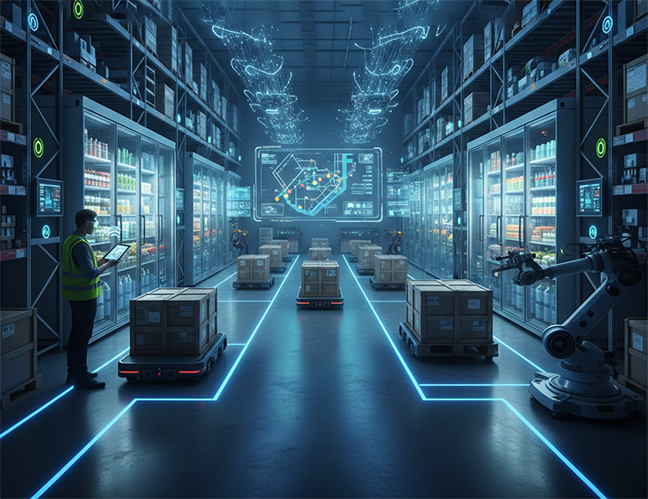
The integration of IoT with artificial intelligence (AI) and robotics creates intelligent warehouse systems that continuously optimise operations through predictive analytics, automated decision-making, and autonomous material handling. IoT sensors provide the real-time data foundation, AI algorithms analyse patterns and predict outcomes, and robotic systems execute physical tasks with precision.
AI-powered platforms process IoT data streams to forecast demand, optimise storage layouts, and schedule replenishment activities before stock-outs occur. These systems learn from historical patterns and adjust recommendations based on seasonal variations, promotional activities, and supply chain disruptions.
- Predictive maintenance algorithms analyse equipment sensor data to schedule repairs before failures occur, reducing unplanned downtime
- Automated guided vehicles (AGVs) and robotic picking systems respond to real-time inventory data, optimising routing and task allocation
- Machine learning models identify inefficiencies in storage density, retrieval times, and labour allocation, suggesting actionable improvements
- Digital twin technology creates virtual replicas of warehouse operations for simulation and scenario planning without disrupting live operations
ATT Group delivers customised IoT-enabled warehouse solutions that integrate seamlessly with existing enterprise IT systems, providing the digital infrastructure necessary for AI and robotics deployment. With expertise in system integration, cloud platforms, and edge computing, ATT enables warehouses to transition from reactive operations to proactive, data-driven management that reduces costs, improves accuracy, and enhances supply chain resilience.
Key Benefits of IoT-Enabled Real-Time Inventory and Cold-Chain Systems
- Real-time visibility eliminates stock discrepancies and enables accurate demand forecasting, reducing both excess inventory and stock-out situations that impact customer satisfaction
- Automated cold-chain monitoring ensures regulatory compliance and product quality for temperature-sensitive goods, preventing costly spoilage and maintaining brand reputation
- Integration with AI and robotics drives operational efficiency through predictive maintenance, optimised storage layouts, and autonomous material handling
- Scalable connectivity solutions like LoRaWAN® provide reliable, low-cost infrastructure that adapts to growing warehouse operations without significant capital investment
- End-to-end data transparency improves supply chain coordination between warehouses, suppliers, and distribution channels, enabling faster response to market changes
Comparison: IoT-Enabled Warehousing vs Traditional Warehouse Management
| Capability | ATT Group IoT Solutions | Traditional Systems |
| Inventory Visibility | ✔️ Real-time, automated tracking across all zones | ✘ Periodic manual counts with delays |
| Cold-Chain Compliance | ✔️ Continuous monitoring with instant alerts | Partial manual logging with gaps |
| Data Accuracy | ✔️ 99%+ accuracy through automated capture | ✘ Error-prone manual entry |
| Predictive Capabilities | ✔️ AI-powered forecasting and maintenance | ✘ Reactive problem-solving only |
| Scalability | ✔️ Modular, expandable architecture | ✘ Limited by manual processes |
| Integration | ✔️ Seamless connection to ERP, WMS, and cloud platforms | Partial siloed systems with manual bridges |
| Compliance Documentation | ✔️ Automated audit trails and reporting | ✘ Manual record-keeping |
Implementing Future-Ready Warehouse Intelligence
IoT-enabled warehousing represents a decisive shift toward intelligent, responsive, and resilient supply chain operations. As customer expectations for speed and transparency continue to rise, the ability to monitor inventory in real-time, maintain cold-chain compliance, and leverage predictive analytics becomes a competitive necessity rather than a technical advantage. Warehouses that adopt integrated IoT, AI, and robotics platforms position themselves to adapt quickly to market disruptions, regulatory changes, and evolving business requirements while reducing operational costs and improving service quality.
ATT Group’s customised enterprise IT solutions provide the digital infrastructure and technical expertise necessary to transform traditional warehouses into intelligent facilities. With ISO-certified quality standards, 24/7 technical support, and proven experience across government and private sector clients in Southeast Asia, ATT delivers scalable, secure, and future-ready systems that integrate seamlessly with existing operations. The company’s commitment to long-term partnerships ensures that warehouse technology investments continue to deliver value as business needs evolve and new capabilities emerge.
Transform your warehouse operations with intelligent IoT solutions contact ATT Group today to discuss customised real-time inventory tracking and cold-chain compliance systems tailored to your operational requirements and regulatory environment.
Contact ATT at infosoft-sales@attsystemsgroup.com for details.
Frequently Asked Questions
Q: What’s the difference between RFID and RTLS for warehouse inventory tracking?
A: RFID tags enable automatic identification and tracking of individual items without line-of-sight scanning, while RTLS (Real-Time Location Systems) pinpoint exact asset positions within large facilities using wireless technology. RFID is ideal for item-level tracking, whereas RTLS excels at providing precise location data across expansive warehouse spaces.
Q: How long do IoT sensors last in cold-chain warehouse environments?
A: IoT sensors using LoRaWAN® technology can operate for 5-10 years on a single battery due to their low power consumption design. This significantly reduces maintenance overhead and operational costs compared to traditional monitoring systems that require frequent battery replacements.
Q: Can IoT warehouse systems integrate with existing ERP and WMS platforms?
A: Yes, modern IoT warehouse solutions integrate seamlessly with existing enterprise IT systems including ERP and WMS platforms through APIs and cloud connectivity. ATT Group specializes in customized integrations that connect IoT sensors with existing business systems without disrupting ongoing operations.
Q: Why is LoRaWAN better than Wi-Fi for warehouse IoT connectivity?
A: LoRaWAN penetrates obstacles like metal structures and storage racks more effectively than Wi-Fi, provides multi-kilometer coverage, operates on battery power for years, and uses unlicensed spectrum to reduce connectivity costs. These advantages make it particularly suited for large, complex warehouse environments where Wi-Fi signals often face interference.
Q: What happens when cold-chain temperature sensors detect a compliance breach?
A: The IoT system immediately notifies warehouse managers through multiple channels including SMS, email, and dashboard alerts, enabling swift corrective action. The system also automatically generates audit-ready documentation that records the temperature deviation, duration, and response actions for regulatory compliance.
Q: How does predictive maintenance work in IoT-enabled warehouses?
A: AI algorithms analyze sensor data from warehouse equipment to identify patterns indicating potential failures, then schedule repairs before breakdowns occur. This proactive approach reduces unplanned downtime, extends equipment lifespan, and prevents disruptions to warehouse operations.
Q: What’s the typical accuracy improvement from switching to IoT inventory tracking?
A: IoT-enabled inventory systems achieve 99%+ accuracy through automated data capture, compared to error-prone manual entry in traditional systems. This dramatic improvement eliminates stock discrepancies, reduces excess inventory, and prevents stock-out situations that negatively impact customer satisfaction.
Contact ATT at infosoft-sales@attsystemsgroup.com for details.
Send us a message
Contact Information
Address:
35 Ubi Crescent, ATT Building, Singapore, 408585
Phone:
Email:
Website:
www.attsystemsgroup.com