Blogs



newsroom
News & Updates
Recent Updates

Categories
Visitor Management Systems vs. Traditional Guest Books
Published: December 18, 2025
Visitor Management Systems vs. Traditional Guest Books
Modern organisations face a critical decision between digital Visitor Management Systems (VMS) and traditional paper-based guest books. This comprehensive ROI analysis examines the financial, operational, and security benefits of transitioning to digital visitor management. We explore cost comparisons, efficiency gains, compliance advantages, and measurable returns that help organisations make informed investment decisions. Discover how ATT’s VMS delivers quantifiable value through reduced processing costs, enhanced security protocols, improved data accuracy, and streamlined visitor experiences. From initial implementation costs to long-term operational savings, this analysis provides the essential metrics decision-makers need to evaluate digital visitor management solutions.
Initial Investment Costs: VMS vs. Traditional Guest Books
The upfront investment comparison between digital VMS and traditional guest book systems reveals significant differences in resource allocation and long-term value creation. While traditional guest books appear cost-effective initially, hidden expenses emerge through manual processing requirements, storage needs, and security vulnerabilities. The true cost of paper-based systems becomes apparent when organisations factor in the labour hours required for data transcription, the physical storage space needed for record keeping, and the administrative overhead of managing compliance requirements manually.
Digital VMS requires higher initial capital investment but delivers immediate operational benefits and measurable efficiency gains that justify the expense within 12-18 months of deployment. Forward-thinking organisations recognise that this initial investment establishes a foundation for scalable, secure, and intelligent visitor management that adapts to growing operational demands. The strategic value becomes evident as facilities experience increased visitor volumes, stricter compliance requirements, and heightened security concerns that traditional systems simply cannot address effectively.
Hardware and Software Investment Analysis
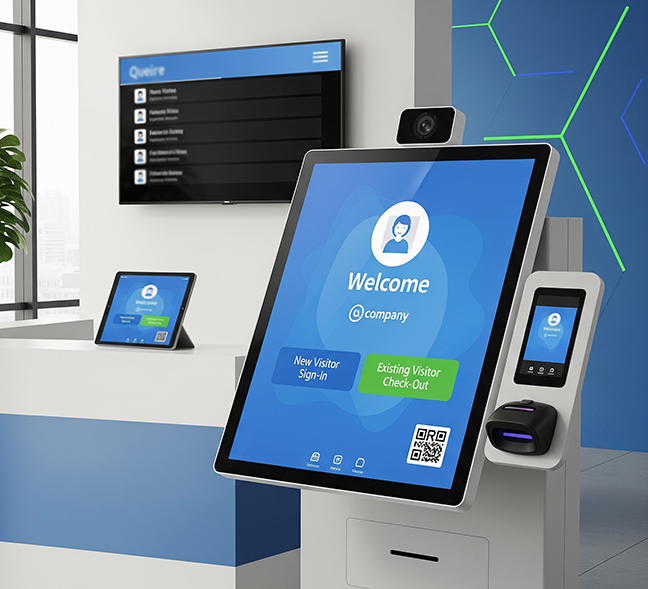
Digital VMS implementation typically requires £12,000-£40,000 for comprehensive deployment across medium-sized facilities, including kiosks, tablets, integration modules, and cloud infrastructure. This investment encompasses self-service terminals, badge printing equipment, security cameras, and backend software licences that form the complete visitor management ecosystem. Traditional systems cost £400-£1,600 annually for books, storage, and administrative supplies, appearing significantly less expensive on paper.
However, VMS eliminates ongoing paper costs, reduces storage requirements by 95%, and automates data collection processes that previously required dedicated staff hours. The hardware investment in VMS pays dividends through reduced consumable expenses, elimination of physical filing systems, and automated processes that would otherwise require manual intervention. Organisations typically recover their initial VMS investment within 18-24 months through operational savings and efficiency improvements.
Implementation and Training Cost Considerations
VMS deployment includes professional installation, staff training, and system integration services typically costing £4,000-£12,000. This comprehensive implementation ensures seamless integration with existing security systems, IT infrastructure, and operational workflows. Professional training covers system administration, visitor management protocols, and emergency procedures that maximise the platform’s capabilities while ensuring staff confidence in daily operations.
Traditional systems require minimal setup but generate ongoing training costs for manual processes, data transcription, and compliance procedures. Staff must be continuously trained on proper documentation techniques, privacy handling procedures, and record management protocols. Organisations report that VMS training investment pays dividends through reduced processing errors, faster visitor registration, and improved staff productivity within the first quarter of operation. The standardised digital processes eliminate training variations and ensure consistent service delivery across all staff members.
Operational Efficiency and Labour Cost Savings

Digital visitor management transforms operational workflows by automating registration, tracking, and reporting processes that traditionally consume significant staff time. The impact extends beyond simple time savings, fundamentally changing how organisations allocate human resources and manage visitor interactions. Staff members previously occupied with manual data entry, phone calls to hosts, and physical escort duties can now focus on security monitoring, customer service enhancement, and strategic operational improvements that add genuine value to the organisation.
Organisations utilising VMS report 60-75% reduction in visitor processing time, allowing personnel to focus on higher-value activities. The automation of check-in procedures, badge printing, and host notifications eliminates manual bottlenecks that often create visitor frustration and operational inefficiencies in high-traffic environments. This efficiency improvement becomes particularly pronounced during peak periods when traditional systems struggle to maintain service quality while digital platforms continue operating at optimal performance levels regardless of visitor volume fluctuations.
Staff Time Reduction and Productivity Gains
Manual guest book processing requires 3-5 minutes per visitor for registration, verification, and host notification. This seemingly brief interaction multiplies significantly in busy facilities, creating queues and delays that impact both visitor satisfaction and staff productivity. Traditional processes involve multiple touchpoints: greeting visitors, explaining procedures, recording information, verifying details, contacting hosts, and managing departure procedures.
VMS reduces this to 30-60 seconds through automated workflows and self-service capabilities. For facilities processing 500+ visitors monthly, this translates to 20-30 hours of staff time savings, equivalent to £320-£640 in labour costs. These savings compound annually while improving service quality. The self-service nature of digital systems empowers visitors to complete registration independently, reducing staff intervention requirements and creating a more streamlined, professional experience that reflects positively on organisational efficiency.
Automated Workflow Benefits
VMS automates visitor badge printing, host notifications, and departure logging without manual intervention. The system instantly captures visitor information, takes photographs, prints professional badges, and sends real-time notifications to hosts via email or SMS. This seamless process eliminates the communication delays and coordination challenges that plague traditional systems, where staff must manually contact hosts and coordinate visitor movements throughout the facility.
Traditional systems require staff to physically escort visitors, manually contact hosts, and track departure times. Automated workflows reduce processing errors by 85%, eliminate double-entry requirements, and provide instant visibility into visitor status. Organisations report improved visitor satisfaction scores and reduced wait times during peak periods. The consistency of automated processes ensures that every visitor receives the same high-quality experience regardless of staff availability or workload pressures, maintaining professional standards even during challenging operational conditions.
Security and Compliance

Security breaches and compliance failures generate substantial financial risks that traditional guest books cannot adequately address. The regulatory landscape continues to evolve, with stricter requirements for visitor tracking, data protection, and audit trail maintenance across sectors including healthcare, finance, and government services. Modern organisations must demonstrate comprehensive visitor management capabilities to satisfy regulatory authorities, insurance providers, and stakeholder expectations for security oversight.
VMS provides comprehensive audit trails, real-time monitoring, and automated compliance reporting that significantly reduce regulatory exposure. The platform maintains detailed records of every visitor interaction, creates tamper-proof digital logs, and enables instant report generation for audit purposes. The cost of a single security incident often exceeds the total investment in digital visitor management, making VMS a critical risk mitigation tool for organisations handling sensitive information or operating in regulated environments where compliance failures result in substantial penalties and reputational damage.
Risk Mitigation Value Assessment
Security incidents cost organisations an average of £120,000-£400,000 in remediation, legal fees, and reputation damage. These costs encompass immediate response activities, forensic investigations, legal proceedings, regulatory fines, and long-term reputation management efforts. Traditional guest books provide minimal security oversight, offering no real-time alerts, limited identification verification, and poor data quality that hampers incident response and investigation activities.
VMS reduces security risks through photo capture, background check integration, and real-time alerts for unauthorised access attempts. The system creates comprehensive visitor profiles, maintains detailed access logs, and provides instant notifications when suspicious activities occur. Traditional guest books provide minimal security oversight and create liability exposure through inadequate visitor tracking and identification verification processes. The proactive security capabilities of VMS often prevent incidents entirely, delivering risk mitigation value that far exceeds the system’s implementation costs.
Compliance Audit Cost Reductions
Regulatory compliance audits require comprehensive visitor records, access logs, and security documentation. Preparing for these audits traditionally involves weeks of manual data compilation, record verification, and documentation assembly. Staff must locate physical records, transcribe handwritten entries, and create comprehensive reports that demonstrate compliance with regulatory requirements across multiple time periods and operational scenarios.
VMS generates these reports automatically, reducing audit preparation time from weeks to hours. The system maintains continuous compliance monitoring, automatically flags potential issues, and produces detailed reports at the touch of a button. Traditional systems require manual data compilation, often resulting in incomplete records and compliance gaps. Organisations report 70-80% reduction in audit preparation costs and improved compliance scores with digital visitor management. The automated compliance capabilities ensure organisations remain audit-ready at all times, eliminating the stress and expense of last-minute preparation activities.
Data Accuracy and Liability Protection
Manual guest books suffer from illegible handwriting, incomplete information, and missing entries that compromise security and create legal vulnerabilities. These data quality issues become particularly problematic during incident investigations, insurance claims, or legal proceedings where accurate visitor records are essential evidence. Poor data quality can invalidate insurance coverage, complicate legal defence strategies, and create additional liability exposure for organisations.
VMS ensures 99.5% data accuracy through mandatory field validation, digital signatures, and automated verification processes. The system prevents incomplete registrations, validates contact information in real-time, and maintains high-quality digital records that serve as reliable evidence when required. This accuracy improvement reduces insurance premiums, minimises liability exposure, and provides reliable evidence for incident investigations when required. The data integrity advantages of VMS create long-term value through reduced legal risks, improved insurance terms, and enhanced credibility with regulatory authorities and business partners.
Long-Term Maintenance and Operational Costs

The total cost of ownership analysis reveals that traditional guest book systems generate ongoing expenses through paper supplies, storage requirements, and manual processing overhead. These costs accumulate steadily over time, often exceeding the initial investment in digital alternatives within 2-3 years of operation. Hidden expenses include staff time for record management, physical storage space, document retrieval activities, and periodic record destruction services required for privacy compliance.
VMS platforms require software licensing and periodic hardware updates but eliminate consumable costs and reduce administrative burden. Over a five-year period, digital systems typically cost 40-60% less than traditional approaches when factoring in labour, storage, and compliance management expenses. The cloud-based nature of modern VMS solutions ensures automatic updates, reduced maintenance requirements, and scalable performance that adapts to changing operational needs without requiring significant additional investment or resource allocation.
Scalability and Growth Cost Benefits
Expanding traditional guest book systems requires proportional increases in staff, storage, and processing resources. Growing organisations must hire additional reception staff, expand filing systems, and implement more complex manual processes to maintain service quality as visitor volumes increase. These scaling challenges often result in service degradation, increased wait times, and higher operational costs that grow exponentially with facility expansion or increased visitor traffic.
VMS scales efficiently through cloud infrastructure and automated processes, handling volume increases without significant cost additions. The digital platform manages higher visitor volumes through the same hardware and software investment, with cloud-based processing capabilities that adapt automatically to demand fluctuations. Organisations experiencing 25%+ annual visitor growth report that VMS scaling costs are 60-70% lower than traditional system expansion requirements, making digital solutions essential for growing facilities that want to maintain service quality while controlling operational costs.
Data Analytics and Business Intelligence Value
VMS generates actionable insights through visitor analytics, traffic patterns, and operational metrics that traditional guest books cannot provide. This business intelligence capability transforms visitor management from a reactive administrative function into a strategic operational tool that drives informed decision-making across multiple organisational areas. The data collected through digital visitor management provides valuable insights into facility utilisation, peak operational periods, security trends, and visitor behaviour patterns that inform strategic planning and operational optimisation initiatives.
Organisations leverage visitor data to optimise resource allocation, improve service delivery, and identify operational improvements worth thousands in annual savings. The strategic value of visitor analytics often justifies VMS investment independently of operational cost savings. ATT’s VMS platform provides comprehensive reporting capabilities that transform raw visitor data into actionable business intelligence, enabling organisations to make data-driven decisions about staffing, security protocols, facility design, and service delivery improvements that enhance both operational efficiency and visitor satisfaction.
Operational Insights and Optimization Opportunities
VMS analytics identify peak visitor times, popular destinations, and processing bottlenecks that enable operational improvements. The system tracks visitor flow patterns, identifies busy periods, and highlights areas where additional resources or process improvements could enhance efficiency. This granular visibility into operational performance enables managers to make informed adjustments to staffing schedules, facility layouts, and service procedures based on actual usage data rather than assumptions or incomplete observations.
Facilities use this data to adjust staffing schedules, optimise space utilisation, and improve visitor flow management. These insights typically generate 15-25% efficiency improvements worth £8,000-£20,000 annually for medium-sized organisations through better resource allocation and enhanced service delivery. The continuous monitoring capabilities of VMS enable ongoing optimisation efforts that compound over time, creating sustained operational improvements that traditional systems cannot achieve due to their limited data collection and analysis capabilities.
Strategic Planning and Facility Management Benefits
Long-term visitor trends support strategic planning for facility expansion, security investments, and service improvements. VMS data provides historical analysis, seasonal patterns, and growth projections that inform major organisational decisions about infrastructure investments, security upgrades, and operational changes. This strategic intelligence enables organisations to plan proactively rather than reactively, reducing costs and improving outcomes through better-informed decision-making processes.
Traditional guest books provide no analytical capabilities, leaving organisations to make decisions based on incomplete information and subjective observations. This strategic advantage often drives competitive benefits and operational excellence that enhance organisational reputation and efficiency. The comprehensive reporting capabilities of ATT’s VMS platform enable organisations to demonstrate operational improvements to stakeholders, support budget requests with concrete data, and benchmark performance against industry standards to identify areas for continuous improvement and competitive advantage.
Making the Strategic Investment in Digital Visitor Management
The ROI analysis clearly demonstrates that Visitor Management Systems deliver superior financial returns compared to traditional guest books through operational efficiency, security enhancement, and strategic insights. The evidence overwhelmingly supports digital transformation in visitor management, with quantifiable benefits appearing within the first year of implementation and increasing annually as organisations leverage the platform’s full capabilities. The strategic advantages extend beyond cost savings to encompass security improvements, compliance benefits, and business intelligence capabilities that traditional systems cannot provide.
Organisations considering this transition should evaluate their specific requirements, visitor volumes, and compliance needs to maximise implementation benefits. ATT’s VMS solutions provide measurable value through reduced costs, improved security, and actionable analytics that support long-term organisational success. The comprehensive platform integrates seamlessly with existing infrastructure while providing scalable performance that adapts to changing operational demands, ensuring that the investment continues delivering value as organisations grow and evolve in an increasingly digital business environment.
Contact ATT at infosoft-sales@attsystemsgroup.com for details.
Frequently Asked Questions
Q: How quickly can organisations expect to see ROI after switching from a traditional guest book to a Visitor Management System?
A: Most organisations recover their initial VMS investment within 18-24 months through operational savings, reduced labour costs, and improved efficiency.
Q: What are the main hidden costs of using traditional guest books for visitor management?
A: Traditional guest books involve ongoing expenses like staff time for manual entry, storage space, record retrieval, and compliance management, which add up significantly over time.
Q: How does a Visitor Management System improve security compared to paper guest books?
A: VMS platforms offer features like real-time alerts, photo capture, and audit trails that drastically reduce security risks and provide better incident response capabilities than paper logs.
Q: In terms of compliance, what advantages does a VMS provide during audits?
A: A VMS can generate comprehensive audit reports in hours instead of weeks, ensuring organisations remain audit-ready and greatly reducing preparation costs and risks of compliance gaps.
Q: How does ATT’s Visitor Management System specifically enhance data accuracy and reduce organisational liability?
A: ATT’s VMS enforces mandatory data validation and digital signatures, ensuring 99.5% accuracy and reliable records that protect against legal and insurance issues.
Q: Is it easier to scale digital visitor management as an organisation grows compared to traditional systems?
A: Yes, VMS platforms easily handle increased visitor volumes without major new investments, while traditional guest books require more staff and storage as traffic grows.
Q: Can a VMS provide actionable insights that help optimise facility operations?
A: Absolutely; VMS analytics highlight traffic patterns and peak times, allowing managers to adjust staffing and improve flow, often resulting in 15-25% efficiency gains.
Contact ATT at infosoft-sales@attsystemsgroup.com for details.
Send us a message
Contact Information
Address:
35 Ubi Crescent, ATT Building, Singapore, 408585
Phone:
Email:
Website:
www.attsystemsgroup.com