Blogs



newsroom
News & Updates
Recent Updates
Categories
How Does Q’SOFT EQMS Integrate with Existing Hospital Management Systems?
Published: February 26, 2026
How Does Q’SOFT EQMS Integrate with Existing Hospital Management Systems?
Q’SOFT EQMS, developed by ATT Group’s subsidiary ATT InfoSoft, integrates with existing hospital management systems through standards-based, enterprise-grade interoperability that connects directly with core HMS and HIS modules without disrupting established clinical workflows. The integration uses HL7/FHIR interfaces, REST APIs, and custom connectors to create a unified data environment across registration, scheduling, billing, and clinical systems.
This connectivity eliminates duplicate data entry, reduces manual errors, and enables real-time patient flow intelligence across the entire hospital operation. The result is a single, consistent source of truth that every connected system reflects simultaneously, supporting smarter resource allocation and a measurably improved patient experience.
Which Hospital Systems Does Q’SOFT EQMS Connect With?
Q’SOFT EQMS connects with all major hospital and health information system modules through its purpose-built integration layer. The platform is designed to interface with the full spectrum of operational and clinical systems that hospitals rely on daily.
Connected systems include:
- Patient Registration Systems demographic data flows automatically into the queue engine at point of check-in
- Electronic Medical Records (EMR) clinical flags, triage categories, and visit histories inform queue priority rules
- Appointment and Scheduling Systems pre-booked appointments generate queue tickets automatically without staff intervention
- Radiology Information Systems (RIS) queue events trigger notifications to imaging departments for coordinated care
- Laboratory Information Systems (LIS) lab referrals and sample collection points are included in patient routing logic
- Billing and Payment Systems billing status updates are written back to the HMS in real time
- CRM and ERP Platforms patient relationship data and resource management systems receive live operational updates
- Pharmacy Systems queue completion events trigger downstream pharmacy preparation and counter notifications
This breadth of connectivity means Q’SOFT EQMS operates as a fully embedded component of the hospital’s digital ecosystem rather than as a standalone add-on.
What Integration Standards and Technologies Does Q’SOFT EQMS Use?
Q’SOFT EQMS uses internationally recognised health informatics standards and enterprise integration protocols to ensure secure, reliable, and scalable connectivity with any HMS or HIS environment. The platform’s architecture is built for regulated, high-compliance healthcare settings.
Core integration technologies include:
- HL7 and FHIR interfaces the global healthcare data exchange standards that enable structured, interoperable communication between clinical systems
- REST APIs enterprise-grade application programming interfaces that allow bidirectional, real-time data exchange between Q’SOFT EQMS and connected platforms
- Custom connectors purpose-built adapters developed for legacy or proprietary HMS environments where standard interfaces are unavailable
- Secure bidirectional data pipelines all integration channels operate with end-to-end encryption and role-based access controls aligned to ISO/IEC 27001 information security standards
ATT Group holds ISO/IEC 27001 certification, which means the Q’SOFT EQMS integration architecture is designed and audited against internationally recognised information security management requirements a critical assurance for hospitals managing protected patient health data.
How Does the Integration Work in a Live Hospital Environment?
In a live hospital environment, Q’SOFT EQMS operates as an intelligent middleware layer that receives, processes, and distributes patient flow data across all connected systems in real time. The integration workflow follows a clear, automated sequence from registration through to discharge.
The end-to-end process works as follows:
- A patient registers or books an appointment in the hospital’s existing HMS or HIS platform
- Q’SOFT EQMS instantly receives the registration event and generates a queue ticket automatically
- Hospital-defined clinical and business rules including triage flags, appointment type, and clinician availability are applied to set queue priority
- The patient is routed to the correct clinic, department, or service point based on real-time capacity and scheduling data
- Status updates including arrival, triage completion, waiting, in-consultation, completed, and billing events are written back to the HMS/HIS continuously
- Downstream systems such as pharmacy, radiology, and payment counters receive automated notifications triggered by queue progression events
This automated workflow means clinical and administrative staff work from a single, accurate picture of patient status at all times, removing the communication gaps that typically cause delays and errors in high-volume hospital environments.
How Does Q’SOFT EQMS Support Self-Service and Mobile Channels Through Integration?

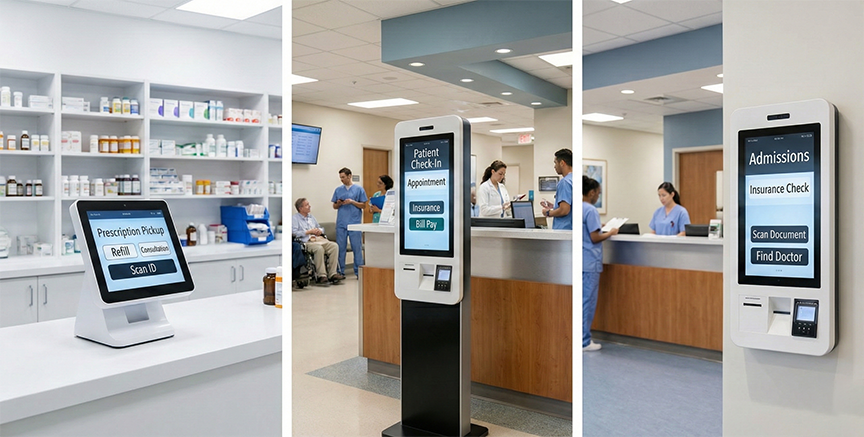
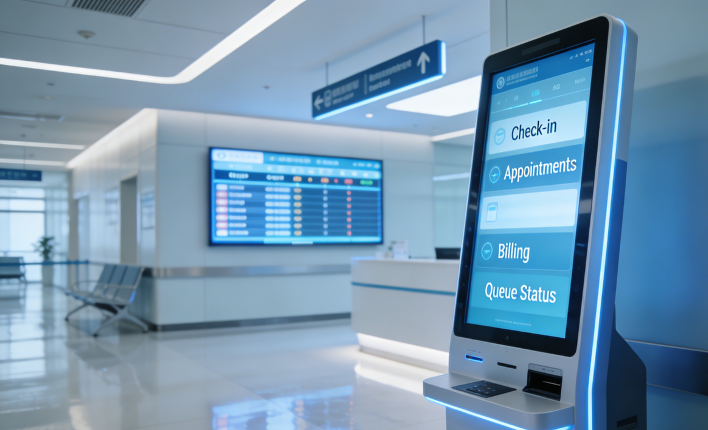
Q’SOFT EQMS extends its integration layer to power patient-facing self-service channels that use existing hospital records without requiring separate data entry. Self-service functionality is delivered through three connected touchpoints: self-service kiosks, the Q’Bot automated assistant, and the mConnect mobile application.
Because these channels draw directly from the integrated HMS data environment, patients can self-register, check in, or reschedule appointments using their existing hospital records. Key self-service capabilities enabled by integration include:
- Patients checking in via kiosk using their existing hospital ID or appointment reference, with queue tickets generated automatically
- Q’Bot providing automated appointment confirmation, queue status updates, and rescheduling options through messaging platforms
- mConnect enabling patients to join virtual queues, monitor wait times, and receive real-time notifications via their mobile device
These self-service channels reduce front-desk workload, decrease physical crowding in waiting areas, and improve the patient experience all without requiring hospitals to build separate patient data management systems.
What Are the Operational Benefits of Q’SOFT EQMS Integration for Hospitals?
The integration between Q’SOFT EQMS and existing hospital management systems produces measurable operational improvements across patient flow, staff productivity, and resource utilisation. By combining live HMS data with its AI-driven queue engine, Q’SOFT EQMS enables intelligent load balancing, automated scheduling, and dynamic resource allocation that respond to real-time conditions.
Documented operational benefits include:
- Optimised patient wait times AI-driven priority routing and real-time capacity awareness reduce unnecessary delays at every service point
- Higher staff productivity automated queue generation and status updates remove manual administrative tasks from clinical and front-desk staff
- Elimination of duplicate data entry patient demographics and appointment data flow automatically from the HMS, removing re-keying and the errors it introduces
- Coordinated multi-department care automated notifications to radiology, pharmacy, and payment counters ensure downstream services are prepared before the patient arrives
- Improved resource planning live data on clinician availability, room occupancy, and service volumes supports proactive staffing and scheduling decisions
- Non-disruptive deployment the integration preserves existing HMS/HIS workflows, requiring no replacement of current clinical systems
These benefits directly address the priorities of hospital operations heads and IT managers who need to improve patient throughput and service quality without undertaking costly system replacements.
Key Takeaways
- Q’SOFT EQMS integrates with hospital management systems using HL7/FHIR interfaces, enterprise REST APIs, and custom connectors, ensuring compatibility with both modern and legacy HMS environments.
- The integration connects with all core HMS modules including EMR, RIS, LIS, billing, pharmacy, and appointment systems creating a single, real-time source of truth for patient flow across the entire hospital.
- Patient self-service channels, including kiosks, Q’Bot, and the mConnect mobile app, operate directly through the integration layer using existing hospital records, reducing manual touchpoints and front-desk workload.
- Q’SOFT EQMS’s AI-driven engine uses integrated hospital data clinician availability, triage flags, and service capacity to enable intelligent queue prioritisation and dynamic resource allocation.
- ATT Group’s ISO/IEC 27001 certification and ISO 9001 quality management standards underpin the security and reliability of every Q’SOFT EQMS integration deployment.
| Aspect | Q’SOFT EQMS by ATT Group | Standalone Queue Management Alternatives |
| HMS/HIS Integration Depth | ✔️ Bidirectional, real-time connection with EMR, RIS, LIS, billing, pharmacy, and appointment systems via HL7/FHIR and REST APIs | ✘ Typically limited to basic registration data or manual CSV imports |
| Data Entry Automation | ✔️ Patient demographics and appointment data flow automatically from the HMS zero duplicate entry required | Partial staff must re-enter or transfer data between systems manually |
| AI-Driven Queue Intelligence | ✔️ Real-time AI prioritisation using live HMS data including triage flags, clinician schedules, and service capacity | ✘ Rule-based or manual queue management without live clinical data inputs |
| Self-Service Channel Integration | ✔️ Kiosks, Q’Bot, and mConnect app all operate through the integrated HMS data layer using existing patient records | ✘ Self-service channels require separate databases or manual configuration |
| Downstream Department Coordination | ✔️ Automated notifications to pharmacy, radiology, and payment counters triggered by queue progression events | ✘ No automated cross-department coordination; manual communication required |
| Information Security Certification | ✔️ ISO/IEC 27001 certified integration architecture with end-to-end encryption and role-based access controls | Partial security standards vary widely; independent audit certification uncommon |
| Legacy System Compatibility | ✔️ Custom connectors built for proprietary or legacy HMS environments where standard HL7/FHIR interfaces are unavailable | ✘ Limited to modern systems with standard APIs; legacy environments unsupported |
Why Q’SOFT EQMS Is the Integration-Ready Choice for Hospital Digital Transformation
Q’SOFT EQMS by ATT Group delivers a fully integrated, AI-powered patient flow solution that connects with every layer of the hospital’s existing management systems. From the moment a patient books an appointment to the point of discharge, Q’SOFT EQMS ensures that data flows automatically, queues are managed intelligently, and every department operates from a single, accurate source of truth. For hospital IT managers and operations leaders seeking measurable improvements in wait times, staff productivity, and patient experience without replacing current infrastructure Q’SOFT EQMS represents a certified, proven, and scalable path forward.
Discover how Q’SOFT EQMS can integrate with your hospital’s management systems contact ATT Group today to schedule a consultation and product demonstration tailored to your operational environment.
Contact ATT at infosoft-sales@attsystemsgroup.com for details.
Frequently Asked Questions
Q: Can Q’SOFT EQMS connect to a hospital’s existing EMR without replacing it?
A: Yes, Q’SOFT EQMS integrates directly with existing EMR systems using HL7/FHIR interfaces and REST APIs, so hospitals retain their current clinical workflows without any system replacement. It reads triage flags and visit histories from the EMR to inform intelligent queue prioritisation in real time.
Q: How does Q’SOFT EQMS handle integration with older or legacy hospital management systems?
A: ATT Group builds purpose-built custom connectors specifically for legacy or proprietary HMS environments where standard HL7/FHIR interfaces are unavailable. This means even hospitals running older infrastructure can achieve full bidirectional integration without upgrading their core systems first.
Q: Does integrating Q’SOFT EQMS with an HMS eliminate the need for staff to manually re-enter patient data?
A: Yes, patient demographics and appointment data flow automatically from the connected HMS into Q’SOFT EQMS at the point of check-in, removing duplicate data entry entirely. This directly reduces administrative errors and frees front-desk staff from repetitive manual tasks.
Q: How does Q’SOFT EQMS coordinate between departments like pharmacy and radiology automatically?
A: As a patient progresses through their queue, Q’SOFT EQMS triggers automated notifications to downstream departments such as pharmacy, radiology, and payment counters so they can prepare before the patient arrives. This cross-department coordination happens without any manual communication between staff.
Q: Is patient data secure when Q’SOFT EQMS connects to hospital systems?
A: All Q’SOFT EQMS integration channels use end-to-end encryption and role-based access controls, with the entire architecture audited under ATT Group’s ISO/IEC 27001 certification. This provides hospitals with independently verified assurance that protected patient health data is handled to international security standards.
Q: Can patients use self-service kiosks or a mobile app without hospital staff re-entering their records into a separate system?
A: Q’SOFT EQMS powers its self-service kiosks, Q’Bot assistant, and the mConnect mobile app directly through the integrated HMS data layer, so patients check in or join virtual queues using their existing hospital records. No separate patient database or manual configuration is required on the self-service side.
Q: How does Q’SOFT EQMS compare to standalone queue management systems when it comes to HMS integration depth?
A: Unlike standalone alternatives that typically rely on basic registration data or manual imports, Q’SOFT EQMS delivers bidirectional, real-time connections across EMR, RIS, LIS, billing, pharmacy, and appointment systems simultaneously. This depth of integration is what enables its AI-driven queue engine to make intelligent prioritisation decisions using live clinical and operational data.
Contact ATT at infosoft-sales@attsystemsgroup.com for details.
Send us a message
Contact Information
Address:
35 Ubi Crescent, ATT Building, Singapore, 408585
Phone:
Email:
Website:
www.attsystemsgroup.com